Sign up for email updates Read about the benefits
Login or    Please leave this field empty
preventing injuries: at home, at play, and on the way.
coalition search


Print This Page

Booster Seat and Seat Belt Safety for Pre-teens and Teens On The Way

 Physical development is key in determining whether an older child should use a booster seat or the adult seat belt. An adult seat belt must be worn properly. It may not fit a small child or pre-teen. They need to use the right restraint for their weight and height. Check your local and state child safety restraint laws, but remember, generally, the law is a minimum requirement.

Enforce safety rules each time passengers ride in your car, while you practice and model safe behaviors as well.

Safety TipTop Tips on Booster Seats and Seat Belts

  • Use either a booster seat with the vehicle lap AND shoulder safety belts or a properly fitted seat belt
  • Be sure your child passes the Safety Belt Fit Test before moving into the adult seat belt.
  • Vehicle seat belts are designed to fit an average-sized adult. To get the best protection from a seat belt, children usually need a booster until they are about 4 feet 9 inches tall and weigh between 80 and 100 pounds. Many children will be between 8 and 12 years of age before they meet these heights and weights.
  • For smaller pre-teens a booster seat may be needed to achieve a proper seat belt fit.
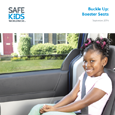
  • A booster seat uses no harness and is not installed in the same way as car seats. They sit on the vehicle seat and are used to properly position the adult seat belt for an older child.
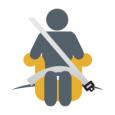
  • Never place the shoulder belt under the child's arm or behind the child's back.
  • Be sure all occupants wear safety belts correctly every time. Children learn from adult role models.
  • Tell all drivers who transport your older, bigger child that booster seat use or seat belt is a must when your child is in their vehicles.
  • Be sure your child buckles up in every vehicle, whether you are there or not.

When your child reaches 4 feet 9 inches and between 80 to 100 pounds, use the Safety Belt Fit Test to determine if the child is big enough to use the adult seat belt without a booster. Use the Safety Belt Fit Test on every child you transport under 13.


The Safety Belt Fit Test

  • Have your child sit in a back seat with his or her bottom and back against the vehicle’s seat back. Do the child’s knees bend at the seat’s edge?

    • If yes, go on.

    • If not, the child must stay in a booster seat.

  • Buckle the seat belt. Does the lap belt stay low on the hips and high on the thighs?

    • If yes, go on. 

    • If it rests on the soft part of the stomach, the child must stay in a booster seat.

  • Look at the shoulder belt. Does it lie on the collarbone and shoulder?

    • If yes, go on.  If it is on the face or neck, the child must remain in a booster seat.

    • Never put the shoulder belt under the child’s arm or behind the child’s back. Do not allow children to play with the shoulder portion of a seat belt. Treat it like any cord.

  • Can the child maintain the correct seating position with the shoulder belt on the shoulder and the lap belt low across the hips?

    • If yes, the child has passed the Safety Belt Fit Test.

    • If no, the child should return to a booster seat and re-test in a month.


Safety TipTop Tips on Seat Belts

Once your child passes the Safety Belt Fit Test, require him or her to use seat belts in a back seat on every ride. Pre-teens and teens are making decisions on their own, and may take risks when they’re alone or with their friends that they wouldn’t take when you’re around. A lap AND shoulder belt provides the best protection to your child and must be used on every ride.

  • Move a child from a booster seat to seat belts in a back seat only after she passes the Safety Belt Fit Test in every vehicle. Return your child to a booster seat if the safety belt does not fit perfectly.
  • Use the Safety Belt Fit Test on any child you transport in your car.
  • Make sure that everyone sits upright when using seat belts. Never let them lean against windows or car doors or lie down. Never put the shoulder belt under the arm or behind the back.
  • Tell all drivers who transport your teen that seat belt use is a must when your child is in their vehicles.
  • Teach your child to use a seat belt in a back seat in every vehicle he or she uses. This is an important habit to establish when the child is young and unsupervised by you. 
  • All children under age 13 should ride properly restrained in a back seat.
  • Wear your seat belt correctly every time you are in a car. Children learn from adult role models.

more safety resources


Safety Tools

There are many tools that parents can use to help to keep children safe from injuries. Many of them are affordable and can be found at many stores.

What you'll need:

Booster seat Booster seat
Local and state child restraint safety laws Local and state child restraint safety laws

change.org youtube- safekids usa facebook - safekids usa twitter - safekids usa
Home Contact Careers Extranet Search Privacy Policy
Safe Kids Worldwide CountDown2DriveSafe Kids Training Academymysafehome.org CPS Tech Certification
1301 Pennsylvania Avenue, N.W., Suite 1000, Washington, DC 20004-1707 | Phone: 202-662-0600 | © 2009 Safe Kids Worldwide

childrens national